The short answer
A useful smart-city curriculum for middle school should ask students to make connected decisions, not simply add technology to a map. EdReal’s 12-week program for ages 10–15 uses a physical planning board, stakeholder needs, infrastructure layers, constraints, and scenario tests so learners can see how one city choice changes transportation, utilities, privacy, resilience, and people elsewhere in the system.
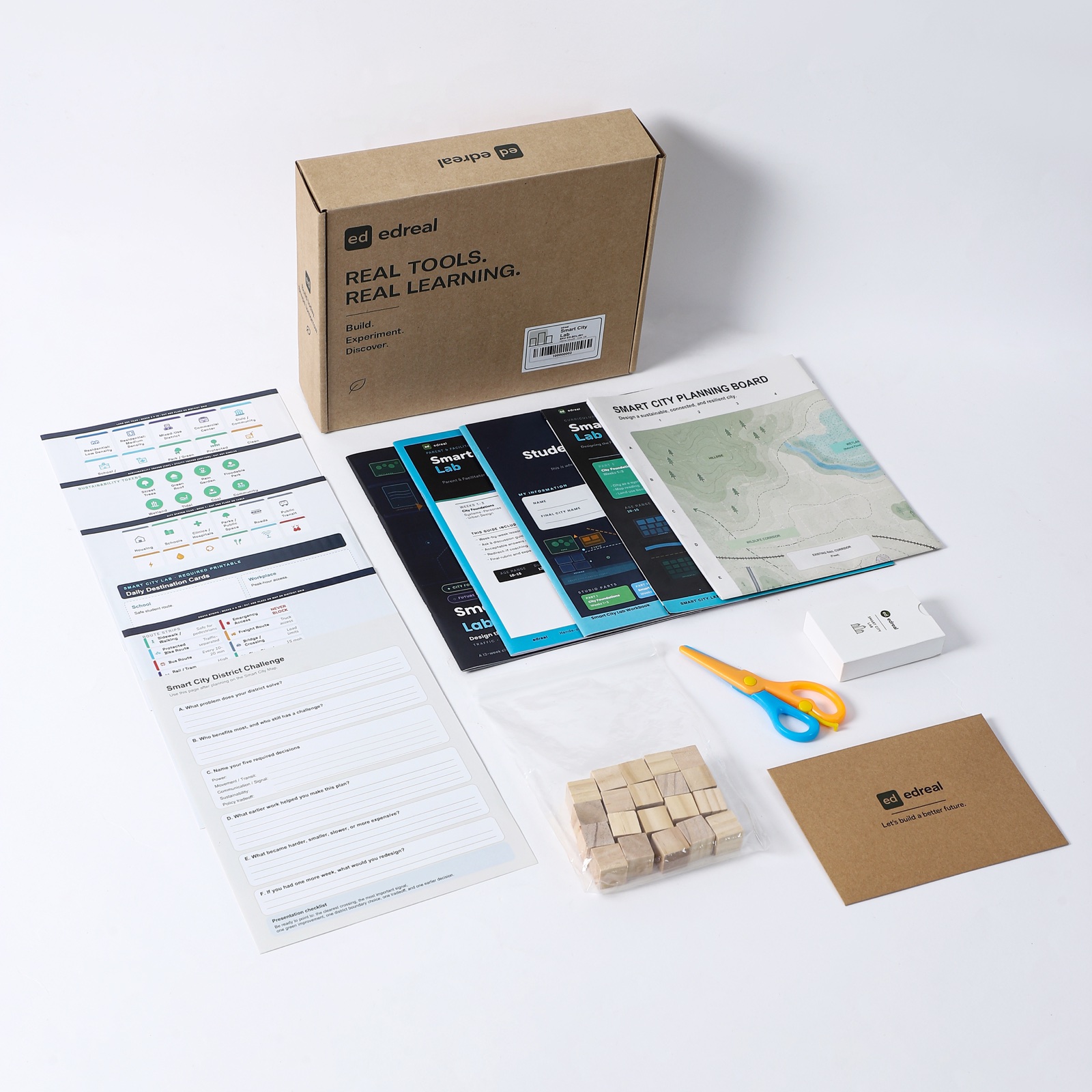
Inside Smart City Lab
- Curriculum package, Parent and Facilitator Guide, student book, and workbook
- A physical city-planning board with printed system pieces
- Wooden planning blocks and a scenario card deck
- Cut-apart activity sheets and student scissors
Photography shows the current product set. The Shopify product page carries the latest contents and availability.
Plan the city as four connected layers
People and place
Learners begin with residents, destinations, access, and the question of who benefits or carries a burden when a plan changes.
Infrastructure
Transportation, energy, water, buildings, and public space must work together on a limited map rather than in isolated worksheets.
Information and rules
Sensors and data may help a system respond, but learners also examine privacy, governance, reliability, and who is responsible for a decision.
Resilience and revision
Disruptions and competing needs force learners to test a plan, defend priorities with evidence, and revise the connected system.
What makes the planning board educational
- A fixed map creates constraints; every desired feature cannot occupy the same space.
- Stakeholder cards make different needs visible instead of assuming one universal definition of a good city.
- Infrastructure layers reveal dependencies between movement, utilities, public space, and data.
- Scenario changes test whether the plan remains useful under stress.
- The capstone requires a defensible plan and revision, not a decorative final map.
Who this city-design program fits
Smart City Lab is designed for ages 10–15 and fits learners who enjoy maps, design, civic questions, infrastructure, policy, and problems with competing priorities. It supports family, homeschool, co-op, microschool, school, and district settings when an adult can facilitate discussion rather than supply a single correct answer.
$120 one-time purchase—equivalent to $10 per week across the complete 12-week curriculum. This is a value comparison, not a weekly subscription. The exact student materials, facilitator guide, hands-on components, and capstone are itemized above.
Buy Smart City Lab from the official EdReal store.
$120 one-time purchase—equivalent to $10 per week across the complete 12-week curriculum. This is a value comparison, not a weekly subscription. Shopify shows the live stock and checkout status.
A curriculum, not a one-afternoon kit
One-off kit
One build, one afternoon. Great for a gift or a quick spark—then it is finished.
Subscription box
A new activity each month, but rarely a connected sequence where later work depends on earlier thinking.
EdReal 12-week curriculum
A complete learning arc: each session revisits the last, adds a system, and asks your child to reason with evidence toward a capstone. Books, workbooks, physical materials, and facilitator guidance are included.
Common concerns
“I am not a STEM expert.”
You do not need to be. The materials, questions, and weekly rhythm are provided—you facilitate the conversation, you do not lecture.
“What connects the full 12 weeks?”
Each week returns to a real question through a hands-on build, test, or decision. Later sessions reuse ideas and evidence from earlier work.
“Is this just more screen time?”
No. The core work is books, a workbook, and physical models. Screens stay minimal or adult-controlled.
Important limits
A classroom planning board simplifies real urban history, finance, law, politics, engineering, and community participation. Learners should treat their proposal as a reasoned model, not proof that one plan would work for every real community.
EdReal Labs are supplementary, inquiry-based learning experiences designed to complement core academic work. They do not claim accreditation, formal district adoption, or replacement of core coursework.
Frequently asked questions
What ages is Smart City Lab for?
The current EdReal age range is 10–15 because the work asks learners to connect several systems and defend tradeoffs among competing needs.
Is smart city learning mainly about sensors?
No. Sensors and data are one layer. The curriculum also examines people, transportation, utilities, resilience, public space, privacy, governance, and connected consequences.
Do students need city-planning software?
No. The core program uses a physical planning board, printed components, a student book, workbook, and facilitated discussion.