The short answer
A strong clean-energy homeschool curriculum for ages 8–13 should let learners compare several energy sources through the same evidence cycle: predict, build, test, record, explain, and improve. EdReal’s 12-week sequence moves through solar, wind, hydro, and storage in three-week Learn, Context, and Create arcs, ending with a capstone comparison. The core materials and facilitator guide are organized for a parent or other non-specialist adult, while the same sequence can also serve a co-op or school.
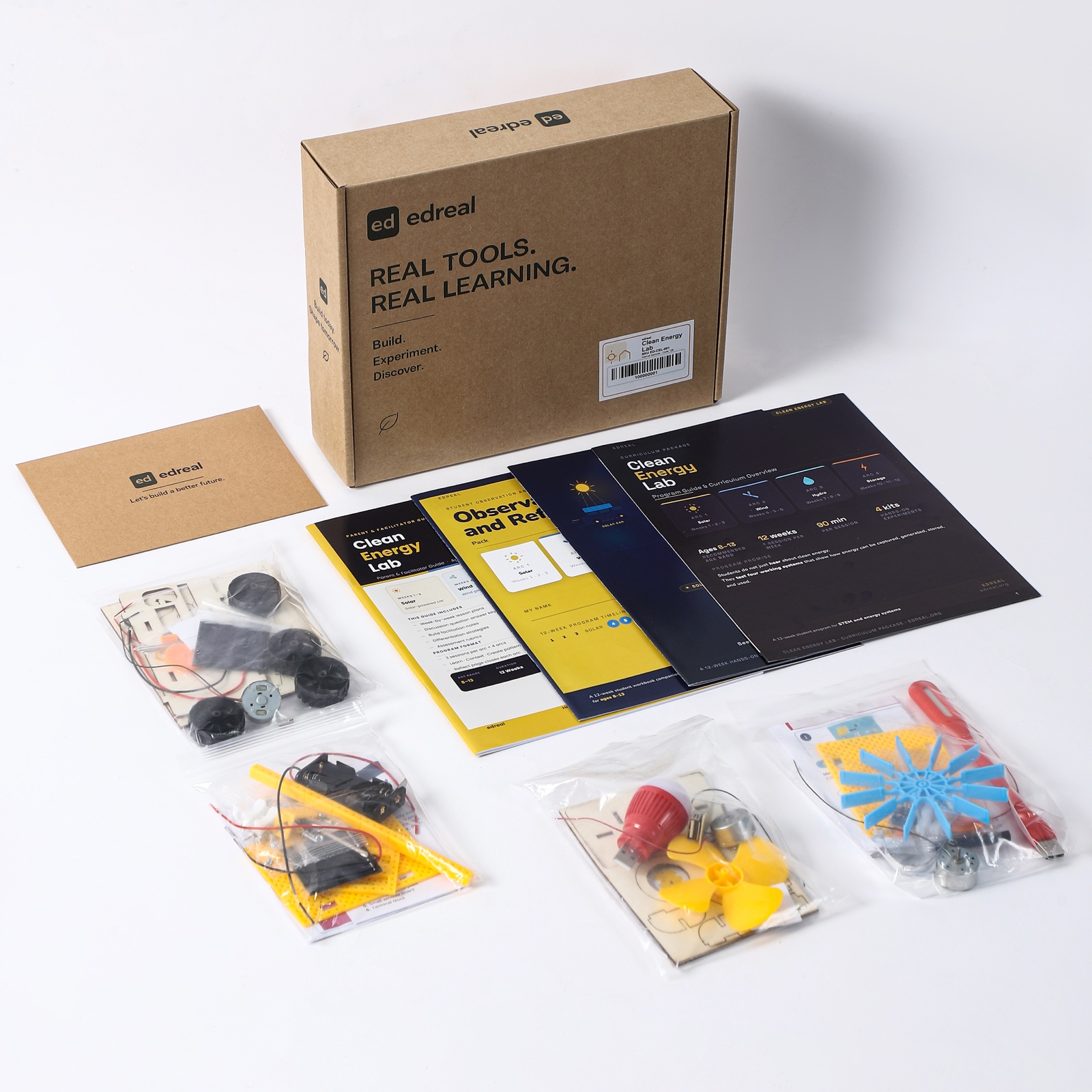
Inside Clean Energy Lab
- Parent and Facilitator Guide, student book, observation and reflection pack, and curriculum overview
- Four hands-on experiment kits: solar car, wind turbine, hydro generator, and solar street lamp
- Build parts and small tools shown with the individual experiment kits
- Welcome and Lab collection cards
Photography shows the current product set. The Shopify product page carries the latest contents and availability.
Four systems, one repeatable evidence cycle
Weeks 1–3 · Solar
Learners trace how light becomes usable electrical energy, examine solar-powered movement, then assemble and test a solar car under different light conditions.
Weeks 4–6 · Wind
They investigate moving air, connect turbine design to real settings, and compare a wind generator’s behavior as test conditions change.
Weeks 7–9 · Hydro
They study moving water, consider dams and micro-hydro, then test how water flow affects a physical hydro generator.
Weeks 10–12 · Storage
They examine why energy must sometimes be saved, compare solar and battery modes, and use semester evidence in a final system recommendation.
What a 90-minute session asks learners to do
- Begin with a prediction or system question instead of assembly instructions.
- Manipulate a physical model and hold important conditions steady.
- Record an observation or measurement that can support a comparison.
- Explain why the result changed and identify a limitation in the test.
- Revise a design, testing rule, or recommendation using evidence.
Who this clean energy program fits
The program is a good fit for learners who enjoy physical science, vehicles and generators, repeated tests, and questions with more than one reasonable design answer. It is designed for families, homeschools, co-ops, microschools, and schools. Younger learners may need shared reading and help recording evidence; older learners can justify comparisons more independently.
$120 one-time purchase—equivalent to $10 per week across the complete 12-week curriculum. This is a value comparison, not a weekly subscription. The exact student materials, facilitator guide, hands-on components, and capstone are itemized above.
Buy Clean Energy Lab from the official EdReal store.
$120 one-time purchase—equivalent to $10 per week across the complete 12-week curriculum. This is a value comparison, not a weekly subscription. Shopify shows the live stock and checkout status.
A curriculum, not a one-afternoon kit
One-off kit
One build, one afternoon. Great for a gift or a quick spark—then it is finished.
Subscription box
A new activity each month, but rarely a connected sequence where later work depends on earlier thinking.
EdReal 12-week curriculum
A complete learning arc: each session revisits the last, adds a system, and asks your child to reason with evidence toward a capstone. Books, workbooks, physical materials, and facilitator guidance are included.
Common concerns
“I am not a STEM expert.”
You do not need to be. The materials, questions, and weekly rhythm are provided—you facilitate the conversation, you do not lecture.
“What connects the full 12 weeks?”
Each week returns to a real question through a hands-on build, test, or decision. Later sessions reuse ideas and evidence from earlier work.
“Is this just more screen time?”
No. The core work is books, a workbook, and physical models. Screens stay minimal or adult-controlled.
Important limits
This is a supplementary inquiry-based program, not an accredited core science course. The models make energy-system ideas visible, but they do not reproduce the scale, efficiency, environmental impact, or economics of real power infrastructure.
EdReal Labs are supplementary, inquiry-based learning experiences designed to complement core academic work. They do not claim accreditation, formal district adoption, or replacement of core coursework.
Frequently asked questions
What ages is Clean Energy Lab for?
The current EdReal age range is 8–13. Age is a starting point; reading independence, comfort with assembly, and the amount of adult facilitation also matter.
Does the program compare more than solar power?
Yes. The 12-week sequence covers solar, wind, hydro, and energy storage, with a physical model and evidence-based comparison for each system.
Is a screen required?
The core work centers on books, a workbook, physical models, observation, discussion, and testing. Brief facilitator media may support preparation, but continuous learner screen use is not the learning environment.