The short answer
EdReal’s Self-Driving Cars Lab is a 12-week curriculum about how autonomous vehicles sense, follow decision rules, navigate routes, encounter edge cases, and require repeated safety testing. Two small robot-car models make selected ideas visible, but the program is not a comprehensive robotics, coding, or professional vehicle-engineering course.
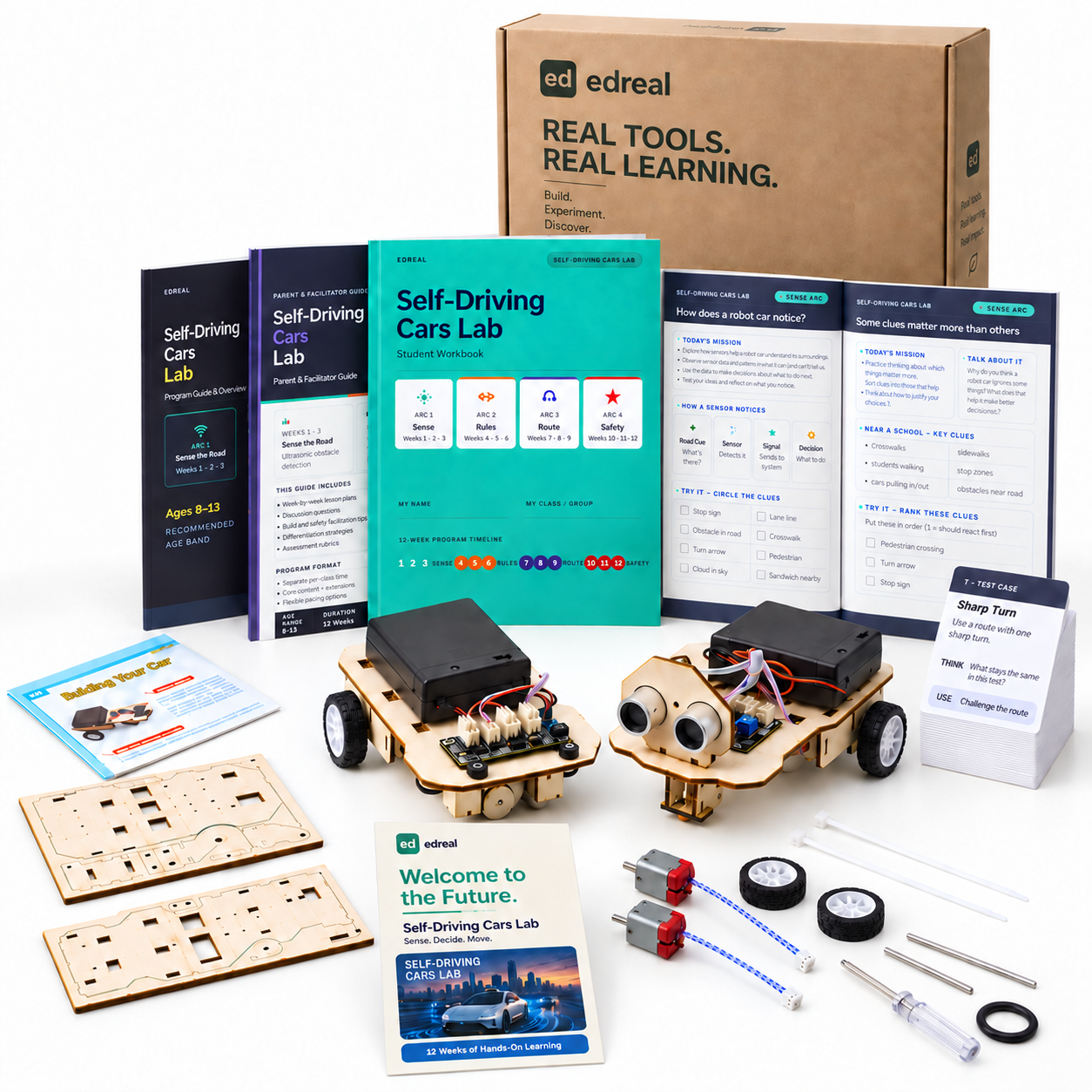
Inside Self-Driving Cars Lab
- Program guide, Parent and Facilitator Guide, student book, and engineering workbook
- Two model-car kits: ultrasonic obstacle avoidance and line tracking
- A 60-card activity deck
- Route and test boards, route tiles, and scene markers
Photography shows the current product set. The Shopify product page carries the latest contents and availability.
The autonomy loop children can see and test
Sense
Learners investigate how an ultrasonic car notices an obstacle and distinguish what a sensor can detect from what a person understands about the scene.
Decide
Physical if/then cards turn rules into objects learners can arrange, question, and revise without hiding the logic behind a screen.
Navigate
Route and line-tracking challenges show that reaching a destination depends on inputs, constraints, sequence, and repeated observation.
Debug for safety
Learners compare expected and observed behavior, identify failure points, and explain why one successful run is not enough evidence of safety.
What screen-free means in this program
- The learner does not need a coding account, laptop, or tablet to complete the core sequence.
- Logic is represented with cards, routes, physical car behavior, predictions, and test records.
- The car’s built-in behavior is something to investigate—not a claim that the learner programmed a full autonomous vehicle.
- Debugging means comparing the rule and environment with observed behavior, then changing one factor deliberately.
- Safety claims require repeated tests and explicit discussion of conditions the model cannot represent.
Who this self-driving cars program fits
The program suits ages 8–13 who are curious about vehicles, sensing, decision rules, routes, safety, and cause-and-effect questions. It can serve families, homeschools, co-ops, microschools, and schools. It is especially useful when an adult wants a structured introduction to autonomous-system thinking without presenting it as a professional robotics or coding course.
$120 one-time purchase—equivalent to $10 per week across the complete 12-week curriculum. This is a value comparison, not a weekly subscription. The exact student materials, facilitator guide, hands-on components, and capstone are itemized above.
Buy Self-Driving Cars Lab from the official EdReal store.
$120 one-time purchase—equivalent to $10 per week across the complete 12-week curriculum. This is a value comparison, not a weekly subscription. Shopify shows the live stock and checkout status.
A curriculum, not a one-afternoon kit
One-off kit
One build, one afternoon. Great for a gift or a quick spark—then it is finished.
Subscription box
A new activity each month, but rarely a connected sequence where later work depends on earlier thinking.
EdReal 12-week curriculum
A complete learning arc: each session revisits the last, adds a system, and asks your child to reason with evidence toward a capstone. Books, workbooks, physical materials, and facilitator guidance are included.
Common concerns
“I am not a STEM expert.”
You do not need to be. The materials, questions, and weekly rhythm are provided—you facilitate the conversation, you do not lecture.
“What connects the full 12 weeks?”
Each week returns to a real question through a hands-on build, test, or decision. Later sessions reuse ideas and evidence from earlier work.
“Is this just more screen time?”
No. The core work is books, a workbook, and physical models. Screens stay minimal or adult-controlled.
Important limits
The physical cars are learning models. They do not reproduce the perception, mapping, prediction, redundancy, regulation, or full safety systems used by real autonomous vehicles. The program teaches foundational reasoning rather than professional vehicle engineering.
EdReal Labs are supplementary, inquiry-based learning experiences designed to complement core academic work. They do not claim accreditation, formal district adoption, or replacement of core coursework.
Frequently asked questions
Is Self-Driving Cars Lab a robotics course?
It uses two robot-car models to make selected ideas visible, but the 12-week curriculum focuses on self-driving-car concepts such as sensing, decision rules, routes, edge cases, repeated testing, and safety reasoning. It is not a comprehensive robotics, coding, or professional vehicle-engineering course.
What ages is Self-Driving Cars Lab for?
The current EdReal age range is 8–13. Younger learners may need more help reading rules and recording observations.
Do learners build a real self-driving car?
No. They use small physical robot-car models to investigate selected sensing, line-following, decision, route, and safety ideas.