The short answer
AI ethics and literacy for ages 8–18 should teach learners to ask where data came from, what pattern a system used, how an output could be wrong or biased, what evidence would verify it, whose privacy or interests are affected, and which decisions must remain human. EdReal’s 12-week sequence practices those questions with printed system maps, cards, scenarios, prompts, and policies; live student AI accounts are not required.
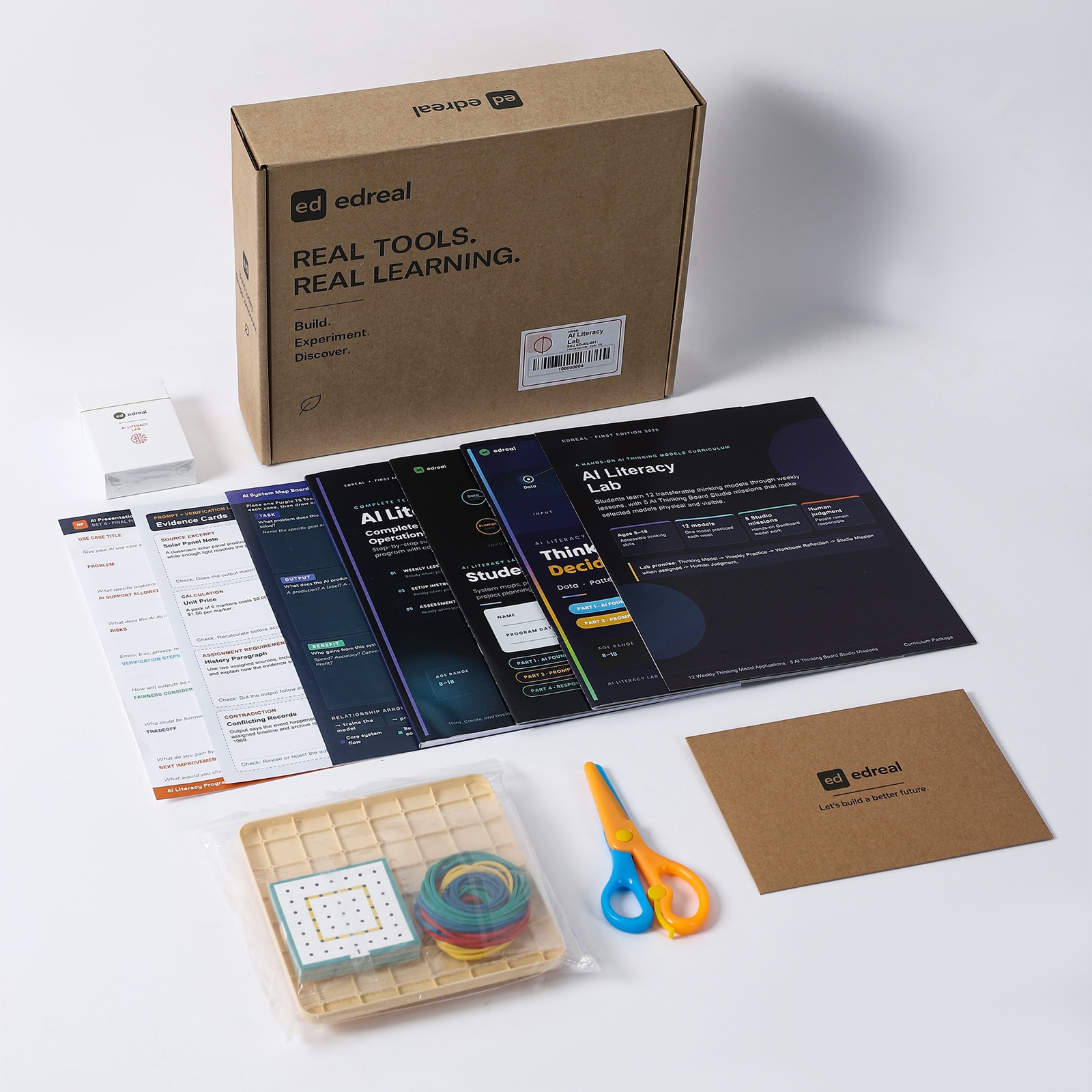
Inside AI Literacy Lab
- Curriculum package, teacher-facing guide, student book, and student workbook
- An activity card deck
- A physical thinking board with pattern cards and colored bands
- Printed system-map, evidence, and final-project activity sheets
Photography shows the current product set. The Shopify product page carries the latest contents and availability.
Four checkpoints behind responsible AI use
What is the task?
Learners distinguish a real goal from the excitement of using a tool and identify what a useful output would need to do.
What data and pattern are involved?
Physical cards and maps show that AI output depends on examples, labels, selected features, and compressed patterns—not understanding in the human sense.
How could the output fail?
Learners inspect errors, missing context, uneven performance, bias, and confident-sounding claims instead of treating fluency as proof.
What should a person verify and decide?
Evidence checks, privacy rules, escalation points, and a human-in-the-loop policy turn caution into an actionable workflow.
Why live student AI access is optional
- Printed system maps make inputs, processing choices, outputs, and affected people visible.
- Output and evidence cards let learners practice verification without entering personal data into a service.
- Prompt activities focus on task clarity, constraints, and evaluation rather than secret formulas.
- Bias and privacy scenarios can be discussed before a learner encounters them in a live product.
- If a live tool is used, an adult can control the account and apply the program’s verification and privacy rules.
Who this AI literacy program fits
The program spans ages 8–18 because the same responsibility questions can be revisited with different levels of reading, independence, and evidence. It fits families, homeschools, co-ops, microschools, schools, and districts seeking structured AI judgment without making individual student accounts the center of instruction. A documented 60-minute option is available alongside the standard 90-minute session.
$120 one-time purchase—equivalent to $10 per week across the complete 12-week curriculum. This is a value comparison, not a weekly subscription. The exact student materials, facilitator guide, hands-on components, and capstone are itemized above.
Buy AI Literacy Lab from the official EdReal store.
$120 one-time purchase—equivalent to $10 per week across the complete 12-week curriculum. This is a value comparison, not a weekly subscription. Shopify shows the live stock and checkout status.
A curriculum, not a one-afternoon kit
One-off kit
One build, one afternoon. Great for a gift or a quick spark—then it is finished.
Subscription box
A new activity each month, but rarely a connected sequence where later work depends on earlier thinking.
EdReal 12-week curriculum
A complete learning arc: each session revisits the last, adds a system, and asks your child to reason with evidence toward a capstone. Books, workbooks, physical materials, and facilitator guidance are included.
Common concerns
“I am not a STEM expert.”
You do not need to be. The materials, questions, and weekly rhythm are provided—you facilitate the conversation, you do not lecture.
“What connects the full 12 weeks?”
Each week returns to a real question through a hands-on build, test, or decision. Later sessions reuse ideas and evidence from earlier work.
“Is this just more screen time?”
No. The core work is books, a workbook, and physical models. Screens stay minimal or adult-controlled.
Important limits
The program does not train a specific commercial AI product, promise technical mastery, or eliminate the need for school and family policies. AI systems and laws change; current tool terms, age rules, privacy practices, and local requirements must be checked separately before live use.
EdReal Labs are supplementary, inquiry-based learning experiences designed to complement core academic work. They do not claim accreditation, formal district adoption, or replacement of core coursework.
Frequently asked questions
What ages is AI Literacy Lab for?
The current EdReal age range is 8–18. Facilitation and the expected depth of evidence should be adjusted across that span.
Do students need a ChatGPT or other AI account?
No. The core curriculum can be completed with printed cards, maps, examples, workbooks, and facilitated discussion. Any live demonstration can remain optional and adult-controlled.
Is prompting the main AI literacy skill?
No. Prompting is one practice within a larger system that includes task definition, data awareness, error and bias detection, evidence checking, privacy, and human responsibility.